TeleHealthMonitor: Edge AI for remote patient monitoring (CamvsCovid)
During the early 2020 COVID-19 surge, Indonesian hospitals needed to monitor high-risk patients at home. Standard systems required broadband and devices such as pulse oximeters or ECG patches. Rural broadband access was below 30%, and medical hardware supply chains were disrupted.
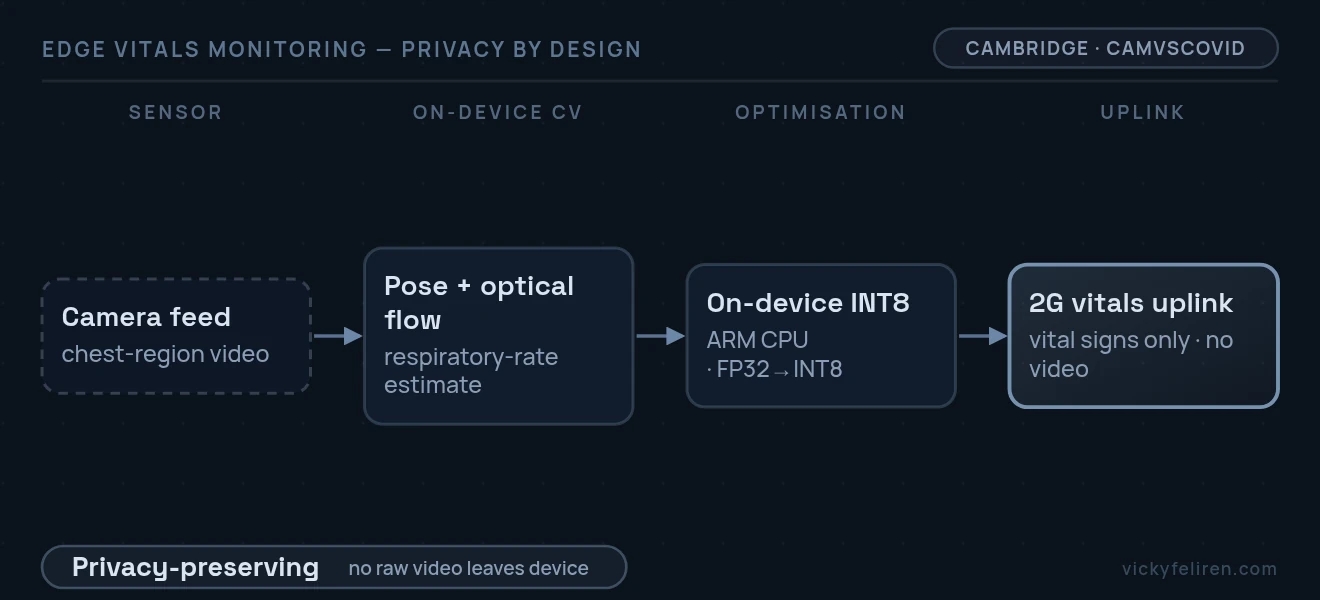
Server-side breathing analysis would overwhelm rural 2G and 3G links because it requires video. Running it on low-end Android phones from 2017–2019 needed model compression and careful runtime tuning. Privacy rules also barred raw patient video from leaving the device, making local inference essential.
Designed an edge-first architecture, with respiratory rate estimation via optical flow analysis on chest region (bounding box from lightweight pose estimation) running entirely on-device. Only the derived vital sign estimate is transmitted to the monitoring dashboard as a single float. Video frames remain on the device. Symptom self-reporting via structured mobile form provides complementary clinical signal.
Model quantized and optimized for ARM CPU inference on target chipset range. Evaluated inference latency and accuracy tradeoff across quantization levels (FP32, FP16, INT8) on physical device testing.
GDPR-compliant by design, so zero raw biometric data leaves the device. Data transmission limited to aggregated vital sign estimates and structured symptom reports.
The project placed in the global top three at Cambridge's COVID-19 innovation challenge. It showed that privacy-compliant vital-sign monitoring could run on ordinary 2019 phones over 2G. The edge-first design also applies to other health deployments with strict limits on bandwidth and hardware.