Flood segmentation from multispectral satellite imagery (ProCANet)
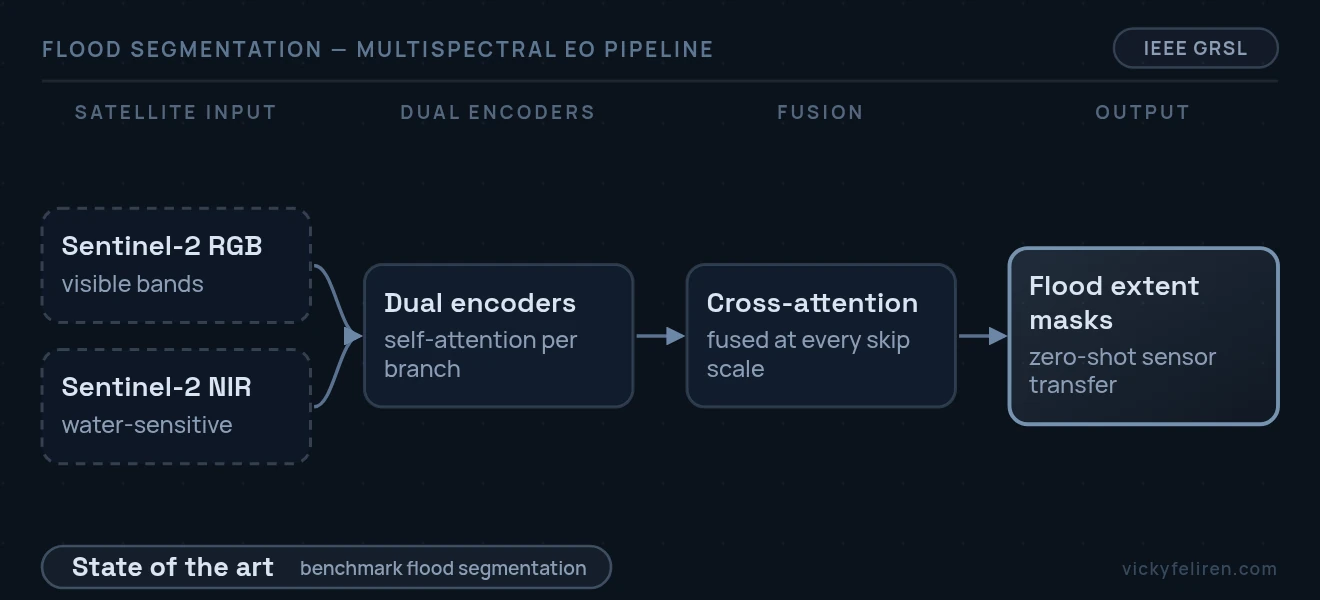
Disaster teams need flood maps before they can plan routes and supplies. Manual GIS analysis takes days or weeks, leaving little time in the first 72 hours of an emergency. The 270 km Citarum River basin in West Java is home to more than 25 million people. It needed an accurate automated system that could map floods across cities, farms, and forests despite partial cloud.
RGB-only U-Nets often confuse flood water with dark soil and shadows. Near-infrared bands from Sentinel-2 help, but they create a fusion problem. The model must combine spectral and spatial information at the same time. Joining RGB and NIR only at the input leaves their features misaligned at the skip connections, where spatial detail passes to the decoder.
I designed ProCANet, a dual-encoder U-Net with separate RGB and NIR branches. Cross-attention at every skip connection combines both inputs at four scales: 1/2, 1/4, 1/8, and 1/16. Self-attention first captures long-range patterns within each branch. This keeps coherent but spectrally different regions from interfering before fusion.
I trained ProCANet on Sen1Floods11, which contains Sentinel-2 images from 11 floods worldwide. Weights & Biases tracked every experiment, including parameter sweeps, loss curves, and per-class IoU checkpoints.
Without retraining, I tested the model on PlanetScope images with six times the training resolution (3 m versus 10 m GSD). Across a 6,112 km² holdout area, it reached 0.659 IoU against NDWI-derived reference labels. This reflects deployment where training and inference use different sensors.
I compared ProCANet with UNet, PSPNet, LinkNet, MANet, PAN, and ConvNeXt V2 under the same Sen1Floods11 protocol. ProCANet reached 0.898 F1 and 0.815 IoU. UNet reached 0.884 and 0.791. These gains are meaningful on a benchmark where performance is already close to its current ceiling.
The system can support disaster response for more than 25 million people in the Citarum basin. It cuts flood mapping from days of manual GIS work to hours after a satellite pass. BNPB can use the earlier map to plan evacuation routes and stage supplies.
- Monash University, Primary research host (A/Prof Risqi U. Saputra)
- University of Indonesia, Domain validation