Municipal waste logistics forecasting, Jakarta Smart City
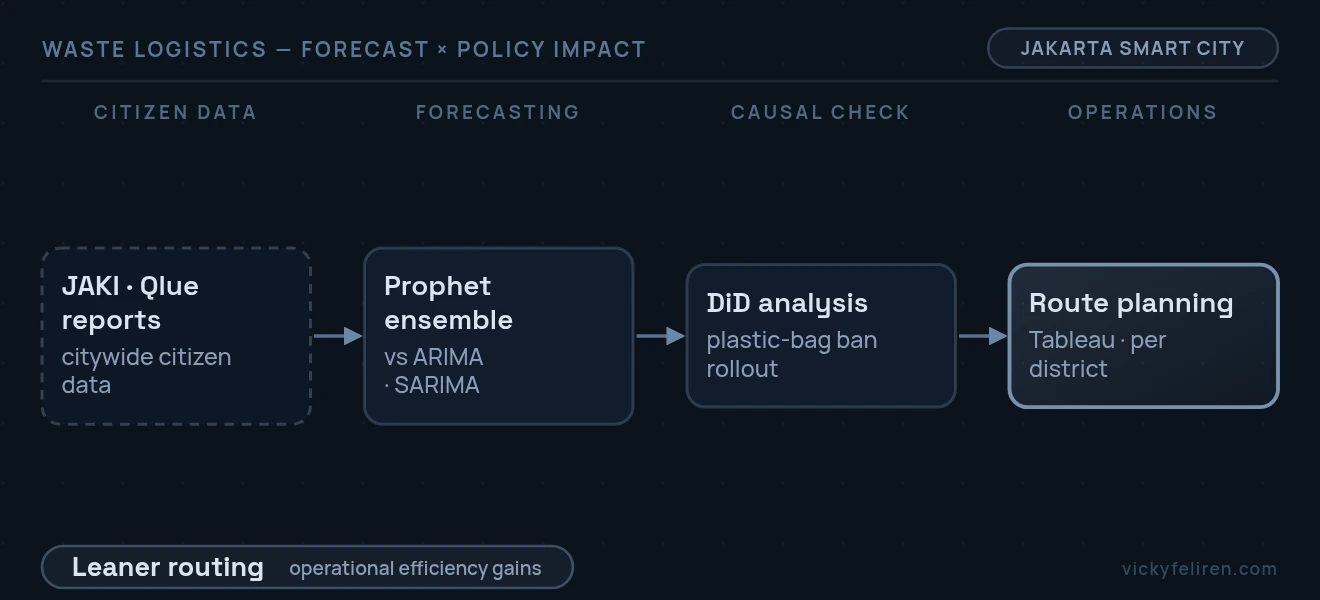
Jakarta's waste agency serves more than 10 million residents across hundreds of collection points. Fixed schedules sent too few trucks to overflowing areas and too many to empty routes. The mismatch increased complaints, fuel use, and emissions.
Waste at each collection point follows noisy and irregular patterns. Lebaran, Christmas, market days, heavy rain, and floods create sudden peaks. One city-wide forecast cannot guide routes. The system needed hundreds of district and site forecasts built from data of uneven quality.
Developed an ensemble time-series forecasting pipeline around Facebook Prophet (primary, for interpretable seasonal component estimation and holiday handling) benchmarked against ARIMA, SARIMA, and exponential smoothing baselines. LSTM explored for capturing non-linear temporal dependencies in high-density districts. Exogenous variables integrated: public holiday calendars, weather data (rainfall, temperature), and local event schedules.
I used more than 100,000 reports from JAKI and Qlue to measure complaint volumes before and after Jakarta's 2020 plastic bag ban. Applied difference-in-differences methodology controlling for seasonal and macroeconomic confounders (COVID-19 mobility restrictions required explicit control). Results provided statistically significant evidence of complaint reduction post-intervention.
Built Tableau dashboards for spatial-temporal analysis of waste volume patterns by district, translated into operational route recommendations for logistics planners. Results and policy findings presented to 500+ attendees at ICISS 2021 (IEEE-sponsored international conference).
The forecasts improved collection efficiency by 15% across a city of more than 10 million residents, reducing fuel use and emissions. The causal study provided evidence on the plastic bag ban and a method for testing future city policies. I presented the first-authored paper internationally at an IEEE-sponsored conference.