Mining footprint detection with multi-modal satellite data
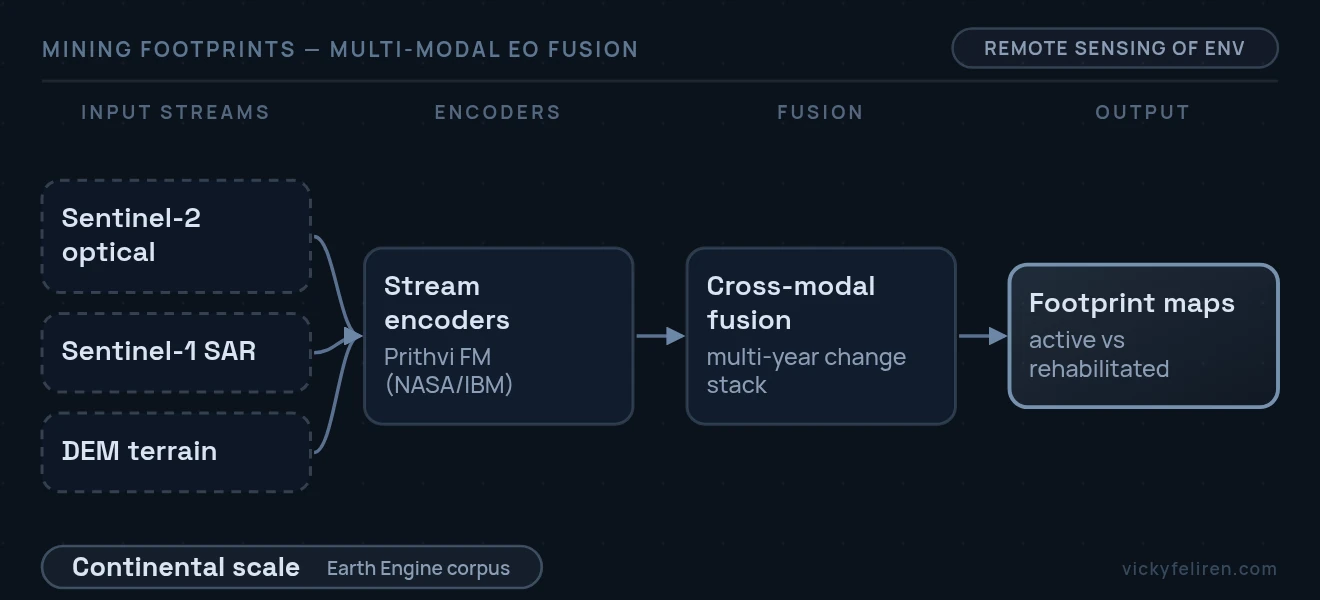
Regulators need accurate mining boundaries to monitor compliance and plan land rehabilitation. In Australia, mapping active and historical sites by hand took GIS analysts months for each region. That cost made continuous national monitoring impractical.
Sentinel-2 images alone do not define mining boundaries reliably. Clouds break the time series. Disturbed land can look like bare soil or dry plants. Optical sensors also miss work underground or below tree cover. Adding Sentinel-1 radar and elevation data helps, but the inputs differ in size, timing, ore type, and biome. The model must combine them without losing those differences.
We built a multimodal pipeline with three inputs: 13-band Sentinel-2 images, Sentinel-1 VV/VH radar, and elevation with slope. A separate encoder aligns features from each source before late fusion. We also fine-tuned NASA and IBM's Prithvi model for mining segmentation. This was the first published use of a geospatial foundation model for the task.
I built ingestion and preparation pipelines for more than 500 GB of labelled multispectral images from Google Earth Engine. I coordinated annotation with geographers at the University of Queensland, UCL, and the University of Nottingham. Agreement checks maintained label quality across ore types and biomes.
We used multi-year image stacks to separate active mines from rehabilitated or historically disturbed land. Australian regulation gives that distinction direct legal and financial importance.
The pipeline replaces months of manual GIS analysis with automated mapping after each satellite update. It supports compliance and rehabilitation work across large mining regions, including state regulation in Australia and ESG reporting by international mining companies.
- Monash University, Primary host (A/Prof Risqi U. Saputra, Prof Alex Lechner)
- University of Queensland, Remote sensing science and annotation
- UCL, Annotation and domain expertise
- University of Nottingham, Annotation and domain expertise