Contributing to llm-d/inference-scheduler, Kubernetes LLM Inference Scheduling
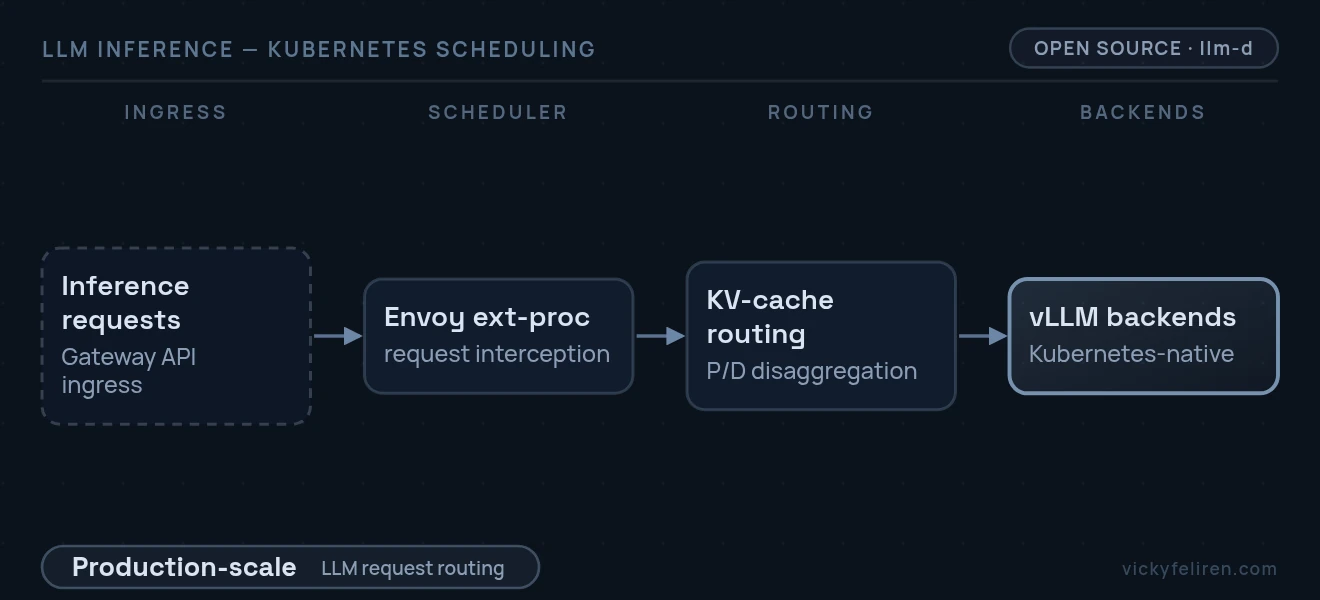
Large language-model services must route requests across several model backends. The llm-d Endpoint Picker Plugin runs in Kubernetes and selects a vLLM backend. It considers current load, where prompt processing occurs, and the KV cache of earlier attention computations. Thus, scheduler work can improve shared open-source infrastructure for serving model responses.
The project connects Gateway API resources, Envoy request callbacks, and vLLM prompt processing and token generation on separate nodes. Moreover, it uses cache-aware scheduling and Kubernetes deployment through Kustomize, Helm, and RBAC access controls. Its Go 1.24+ codebase uses tracing, Prometheus metrics, and modular filters and scorers. Therefore, contributions must preserve clear interfaces that support extensions.
I plan to map how the scheduler intercepts requests and selects GPU backends. Then I will study ways to split prompt processing and token generation across nodes. Moreover, I will study plugins that improve load balancing and KV-cache reuse. I will also locate avoidable delays in request processing.
I want to learn more about Kubernetes operator patterns and ways to extend Envoy proxies. Moreover, I want to deepen my knowledge of distributed model serving and Go concurrency patterns. I will also study infrastructure design for production machine learning. Thus, the project exposes me to practical serving problems across cloud infrastructure and applied machine learning.
I am setting up a local development environment that matches the project’s cluster configuration. Meanwhile, I am reviewing the architecture and its unit, integration, and end-to-end tests. I am also studying deployment modes that separate prompt processing from token generation. After that, I will use local simulation to test changes before contributing upstream.
Planned contributions would improve infrastructure for teams serving language models at scale. The project combines Gateway API, Envoy, and routing that considers reusable KV-cache entries. Moreover, this work builds practical knowledge of distributed machine-learning systems.