HakkTaxi: ride-share demand prediction (Microsoft Azure APAC Hackathon)
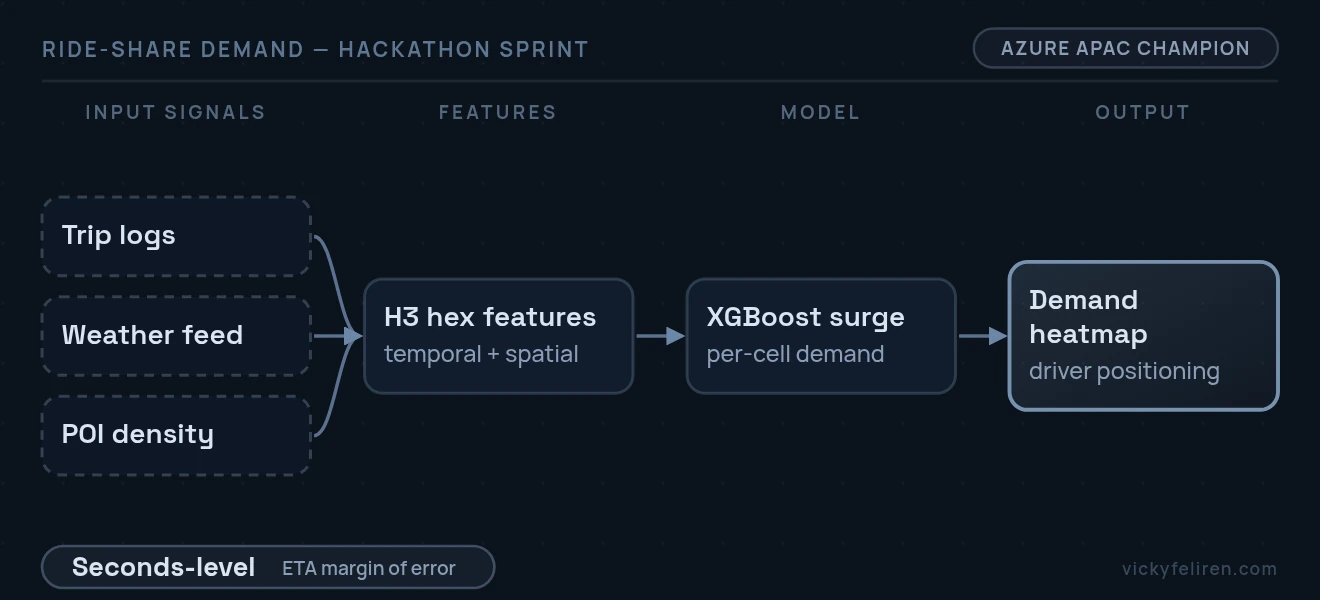
Jakarta ride demand rises during commutes, Friday evenings, and rain. Drivers reacted to surge signals that were already five to ten minutes late. A map forecasting demand 15–30 minutes ahead could move drivers sooner, shorten surges, and make earnings more predictable.
A 48-hour competition left no time to obtain proprietary trip telemetry. I built a demand signal from proxy data, historical totals, weather, and static place density. It had to transfer across Jakarta's varied geography. CBD office clusters, university campuses, market districts, and transit hubs each exhibit fundamentally different demand dynamics that a single model must capture without overfitting. The additional constraint was a system demonstrable in 5 minutes to non-technical judges while withstanding commercial scrutiny from Microsoft product leadership on the jury panel.
In 48 hours, I built an XGBoost demand model from trip history, weather, and point-of-interest density in H3 map cells. Time features covered hour, weekday, holidays, and rolling demand. Place features covered offices, transit, and entertainment. Azure Maps displayed the live demand heatmap.
Competed against teams across Southeast Asia and Australia. Won Regional Champion across APAC, validated against international jury with Microsoft engineering and product leadership as judges.
We delivered the full system, from data ingestion to a live map, within 48 hours. Validation showed a six-second margin of error for ETA. The project won first place across APAC against leading applied ML teams in the region.