Community IVR: Voice AI for offline communities (Cal Hacks 8.0)
During COVID-19, Indonesia shared health advice, social support rules, and emergency information mainly through apps and social media. An estimated 40% of Indonesians had no smartphone. Rural, older, and low-income people lost access to information while facing some of the greatest risks.
Standard phone menus assume patient, literate users and clear speech. They fail with background noise, unfamiliar technology, and local accents. Indonesian speech recognition trained on formal broadcasts performs poorly on Javanese and Sundanese accents or code-switching. The information also changed weekly, including quarantine rules, social aid, and emergency contacts.
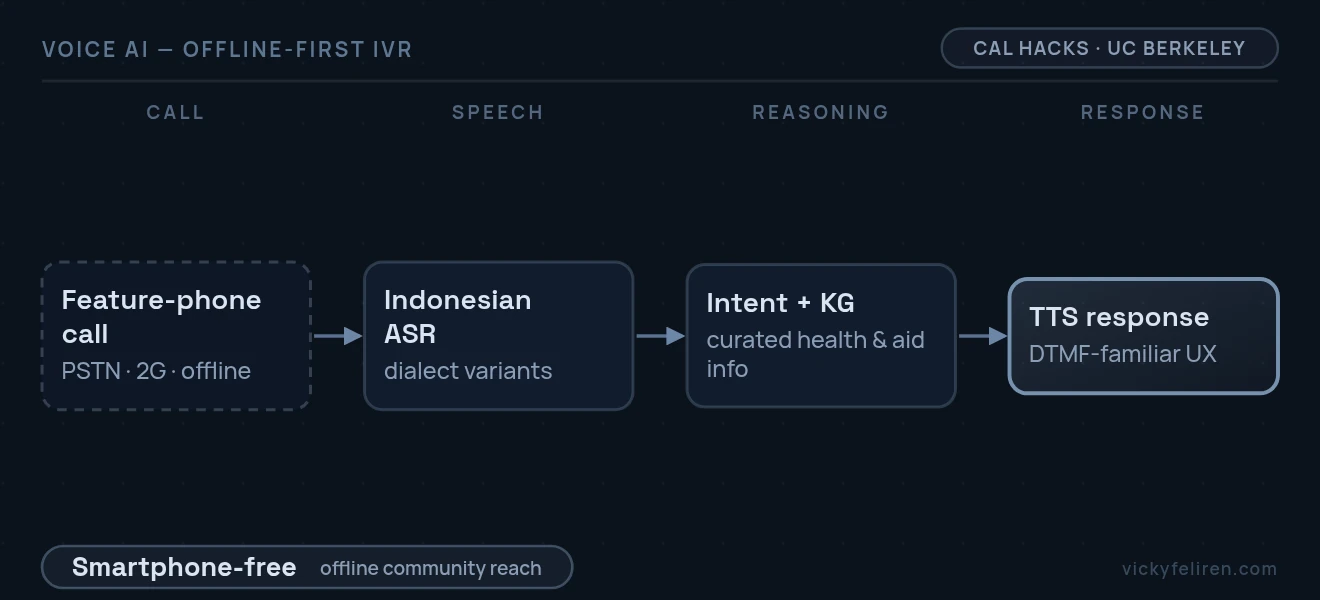
I designed an assistant for basic phones and 2G networks. It required no app or internet service. Speech recognition handled Indonesian with Javanese and Sundanese accents. A knowledge graph stored health advice, service rules, and emergency contacts, while text-to-speech read answers.
Designed for zero digital literacy barrier, so the interaction model mirrors existing DTMF IVR systems that Indonesian users were already familiar with from banking and telecom services. Free-form voice queries supported for users unfamiliar with menu navigation.
We curated the knowledge graph for Indonesia. It covered local health contacts, regional quarantine rules, social-assistance eligibility, and local variations in how people asked questions.
The service addressed a gap affecting the estimated 40% of Indonesians without smartphones. It won Best Community Track at UC Berkeley's Cal Hacks. The same feature-phone, speech, and knowledge-graph design can serve other regions where smartphones and internet access remain limited.