Biometric authentication and alternative credit scoring at scale (GDP Labs)
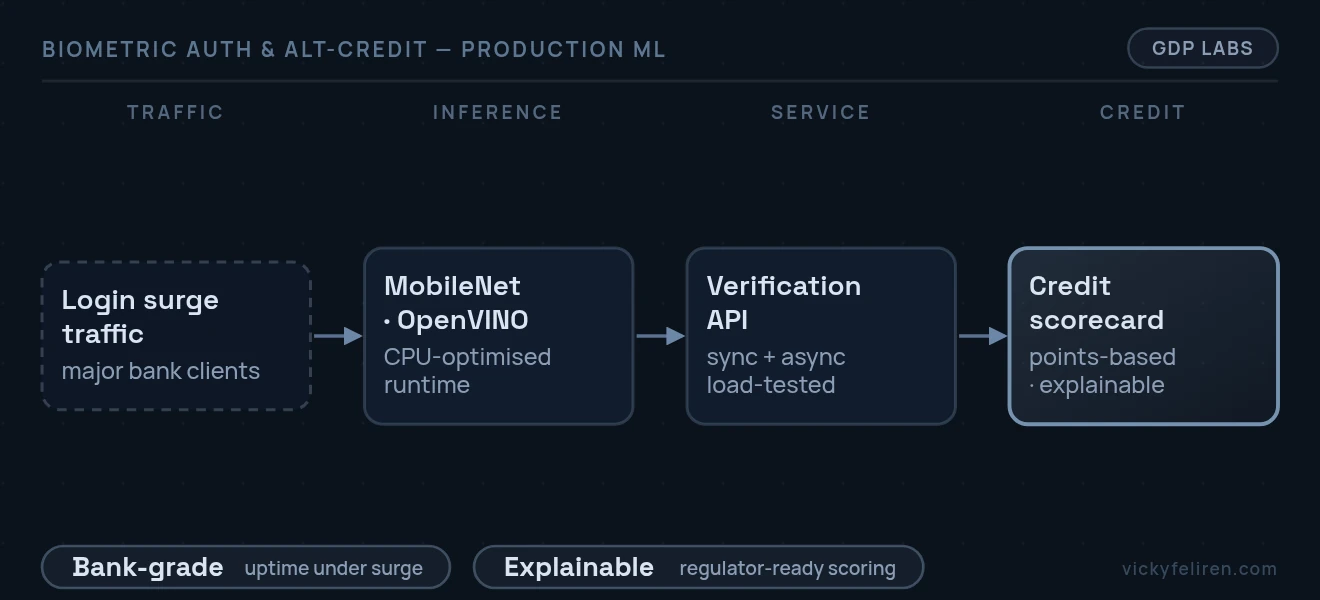
A major Indonesian bank needed biometric authentication that could handle national login peaks. It also wanted to assess thin-file borrowers with too little bureau history for conventional scoring. Indonesia's regulator, OJK, requires explainability and fairness records for deployed credit models.
Attackers use printed photos, replayed videos, and 3D masks against financial biometrics. Detection had to run on CPUs, within strict latency limits, at more than one million requests a day. The credit model also had to be clear to non-specialist OJK auditors and document fairness across demographic groups.
Deployed MobileNet backbone (optimized for CPU inference) under Intel OpenVINO runtime, achieving 90% verification accuracy at 99.99% uptime through login surge peaks of 1M+ daily inferences. Designed synchronous and asynchronous load testing harnesses in JMeter to establish production latency benchmarks and identify bottlenecks before deployment. Anti-spoofing and active liveness modules tested under both sync/async load profiles.
All credit scoring experiments tracked with MLflow (hyperparameter logs, model registry, metric versioning). Shipped a regulatory-explainable scorecard model, a logistic regression converted to a points-based scorecard format interpretable by OJK auditors, with SHAP-based feature importance documented for the fairness review. Alternative data signals used: transaction history patterns, behavioral metadata, and device signals for thin-file borrowers previously excluded from formal credit markets. Validated against a 6-month client-monitored window, delivering 35% higher loan approval efficiency and a 25% lower default rate vs. prior baseline.
Established reproducibility standards (fixed seeds, version-pinned configs, regression benchmarks) adopted across 5+ products. Built scalable serverless clustering API on AWS (Kubernetes, scikit-learn, MLflow) for an analytics platform, 40% increase in business leads reported by client. Set internal code-review bar and automated ML pipeline standards that reduced research-to-production handoff friction company-wide.
Led HR analytics initiative using PrestoDB and Metabase, resulting in 50% productivity measurement improvement for internal operations team.
The credit system expanded access for borrowers that traditional bureaus could not score while meeting OJK requirements. The biometric service protected millions of users from presentation attacks at 99.99% availability, matching a Tier 4 data-centre SLA for ML inference.